
 English
 Lietuviškai
 Dansk
 Deutsch
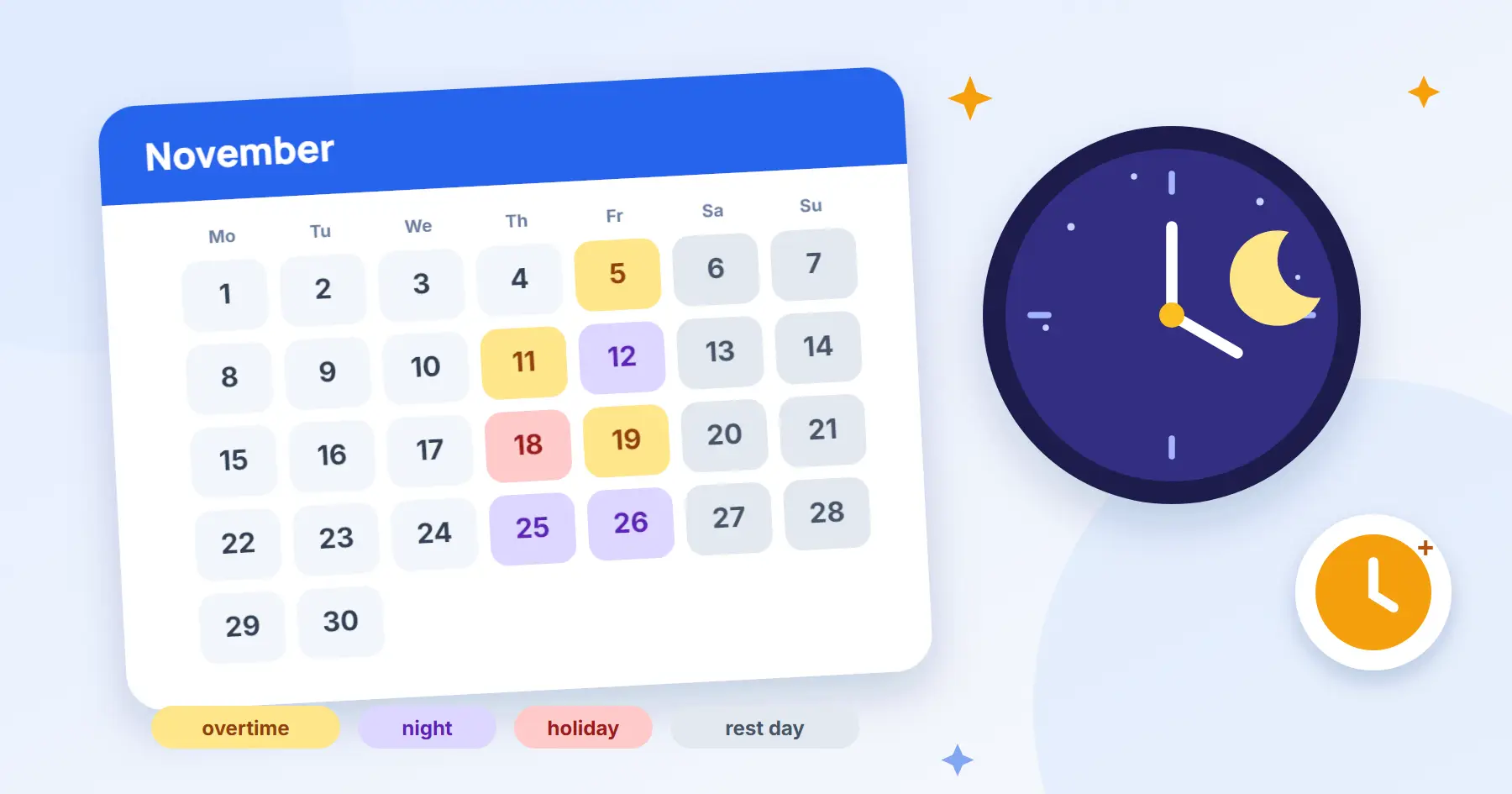
Friday evening. The foreman calls: “We worked Saturday. Is that overtime or a rest day?” The accountant takes a deep breath. If that scene sounds familiar, read on.
In short: these are not the same hours but four different categories. You do not need to memorise the rules. What matters is recording when work started, when it ended and what kind of day it was. The rest can be calculated.
The four kinds of hours
- Overtime is time that goes beyond the set working-time norm.
- Night work is work done during night time. It usually covers late evening and early morning hours, and the exact times are set by the rules of your country.
- Rest days are days when a person was not scheduled to work.
- Holidays are public holidays.
Each kind may be paid differently. We do not give rates here: they depend on the country, the contract and collective agreements, so check them with your accountant or lawyer.
Why they are so easy to mix up
Mostly because they overlap. A shift from 22:00 to 06:00 starts one day and ends the next. If the second day is a public holiday, the same hour can be both night and holiday time. If the shift is also longer than the norm, overtime comes into it too.
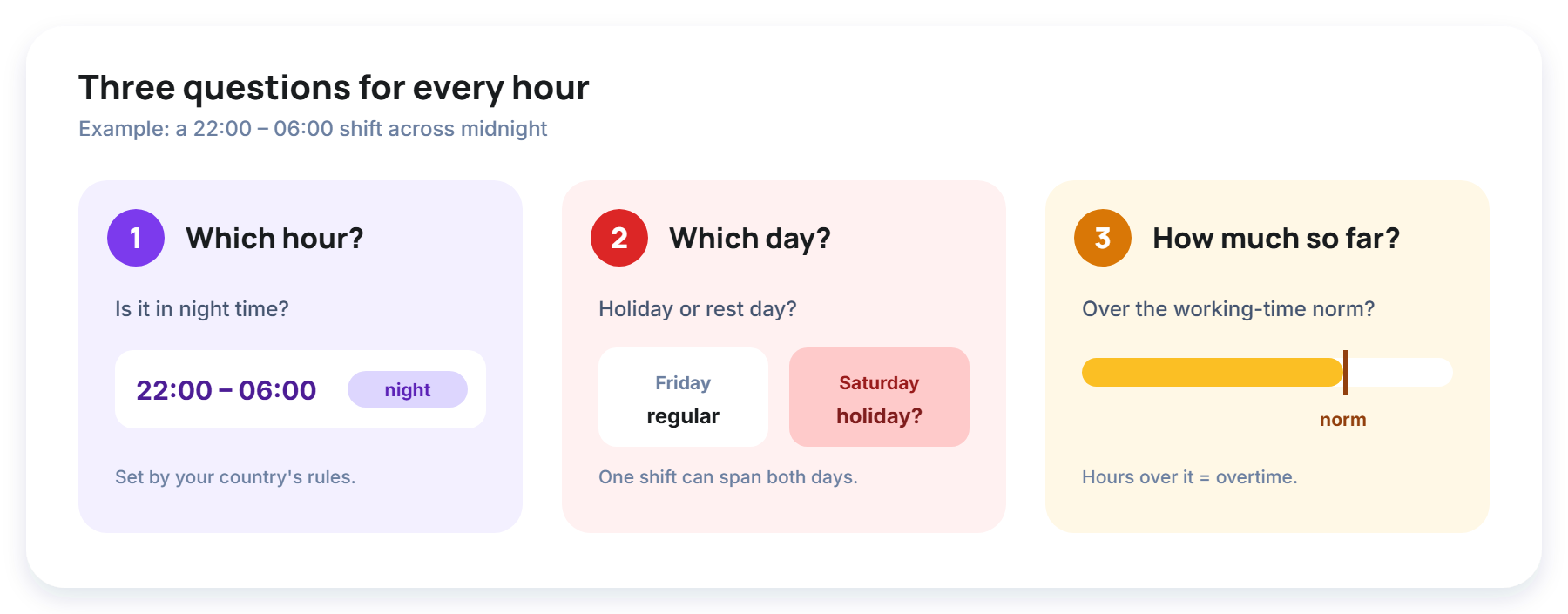
That is why it helps to ask the same three questions about every hour: which hour is it, which day is it and how much has already been worked. The answers decide the category.
An example: one shift, two calendar days
John works from Friday 22:00 to Saturday 06:00 with a 30-minute break. What is worth recording?
- The real start (Friday, 22:00) and the real end (Saturday, 06:00), not “about 8 hours”.
- The break, because it changes how many hours were actually worked.
- That the second part of the shift falls on Saturday. If Saturday is a rest day or a holiday, that part has to be counted separately.
When these details exist, the categories can be worked out automatically. When they do not, all that is left is guessing, and guessing usually ends in recalculation.
How to explain it to the team
People do not need to know the labour code. Two rules are enough: record arrival and departure in real time, and mark the break. Everything else, including which hour is which, should be done by the system or the accountant.
The most common mistakes
- A shift across midnight is written as one line and the status of the second day is forgotten.
- Holidays are not marked because “everyone knows it’s a holiday”.
- Hours are rounded “to look nicer” and mismatches appear.
- Overtime is only calculated at the end of the month, when nobody remembers what happened when.
- Different people count differently because the rules are not written down anywhere.
How Estimy does it
With the Work time module, Estimy sorts worked time into regular, overtime, night, rest-day and holiday hours by your country’s rules. Public holiday calendars are built in, so a holiday shift is recognised without extra marking.
The calculation happens in one place, so the web app and the phone show the same hours, and the same figures end up in the reports you export to Excel or PDF.
Before you start: check with your accountant your working-time arrangement and which hours count as night time or overtime for you. Estimy calculates by your country’s rules, but your contract may provide for more.